Module 8 - Pathway Enrichment Analysis
Veronique Voisin
This module will cover how to use differential expression output to generate pathway enrichment results.
Presentation of the dataset
This module is a continuation of the transcriptomics module 6 and we will use the same dataset. This dataset contains bulk RNA-seq data of a model of breast cancer. The gene counts were deposited to the Gene Expression Omnibus (GEO) database under accession GSE222367 and are publicly available.
RNA was extracted from MCF7, a breast cancer cell line under different conditions: parental cell line and cell line samples resistant to the drugs palbociclib or abemaciclib.
Biological replicates were available for each condition.
RNA-seq library was prepared and sequenced using an Illumina HiSeq 2500 sequencer.
Sequence reads were mapped to the human reference genome (Gencode GRCh38) using TopHat as aligner.
The BAM files with mapped reads for each sample were sorted and then used as input for HTSeq 0.11.0 in order to generate read count data at the gene level.
We retrieved the gene counts and performed differential expression analysis using a negative binomial generalized linear model, followed by pathway enrichment analysis.
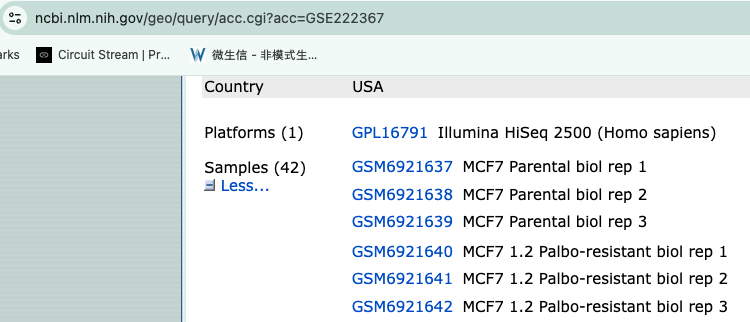
Figure 1: GEO dataset